👋 Introduction
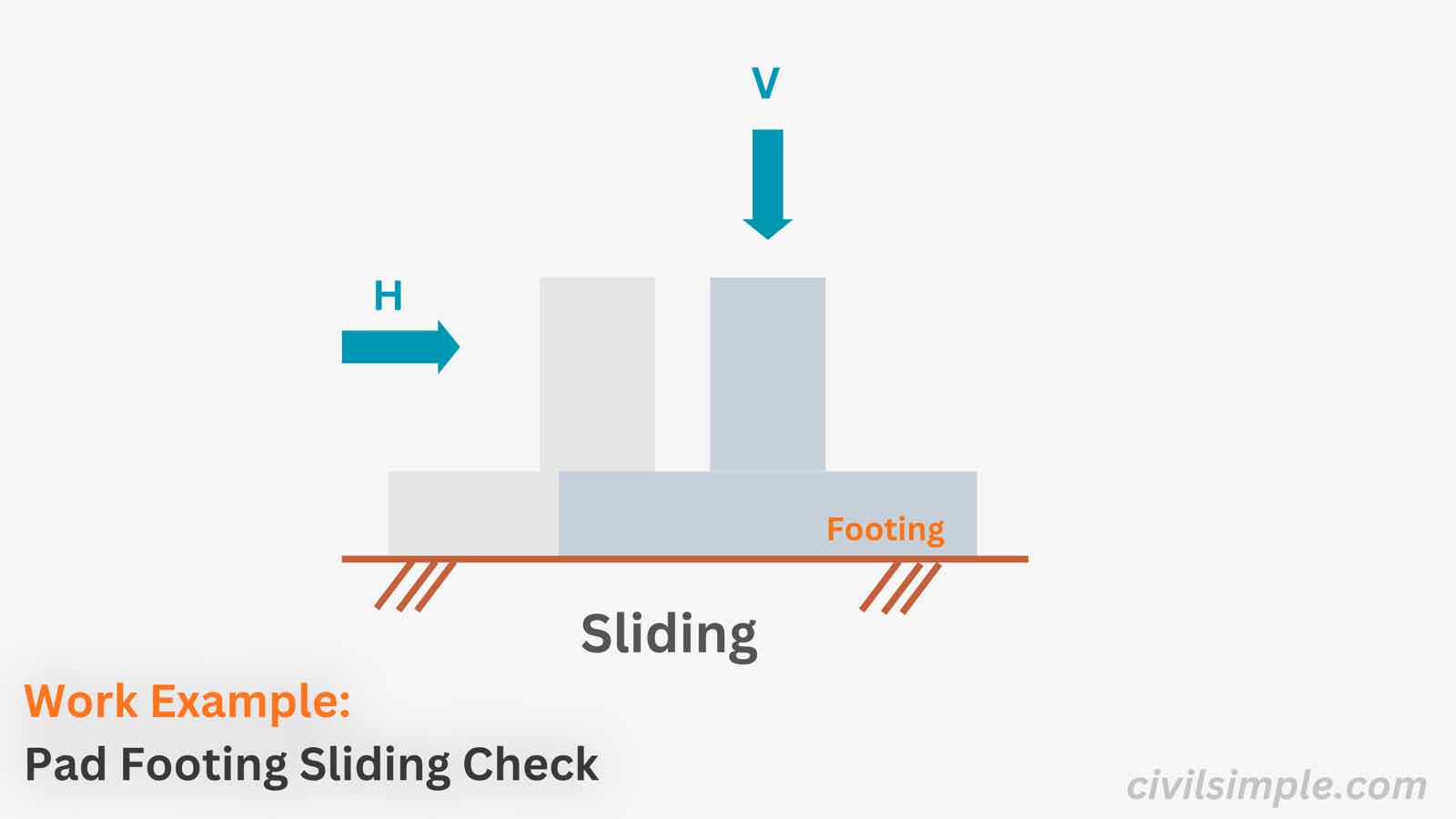
A horizontal force — wind, earth pressure, seismic action — tries to drag a footing sideways along the ground. The only resistance is the friction between the base and the soil. This work example runs the sliding check of a 3.0 m × 3.0 m pad footing, 1.0 m deep, carrying a horizontal force Fy = 30 + 10 kN and a vertical force Fx = 20 + 8 kN, in the same order a calculation report runs it:
- Sliding force — the horizontal force at service level
- Self weight and friction — the weight that presses the base down and the resistance it creates
- Sliding check — resistance against force, with the required factor of safety
The concept behind each step is explained in the companion article: Pad Footing Stability Check: Sliding, Overturning and Bearing Capacity - A Simple Guide.
📐 Design Data
Below is the design information of the pad footing, which we will check under the horizontal force.
| Pad Footing | ||
|---|---|---|
| Type | Pad footing (concrete) | |
| Length, L | 3.0 m | |
| Width, W | 3.0 m | |
| Depth, D | 1.0 m |
| Design Loads | ||
|---|---|---|
| Vertical Force, Fx (Dead / Live) | 20 kN / 8 kN | |
| Horizontal Force, Fy (Dead / Live) | 30 kN / 10 kN |
| Soil and Safety Factor | ||
|---|---|---|
| Friction Coefficient, μ | 0.35 | |
| Factor of Safety, Sliding | 1.5 |
| Load Combination (SLS) | ||
|---|---|---|
| Dead Load Factor, fDL | 1.0 | |
| Live Load Factor, fLL | 1.0 |
🔢 Calculation Steps
1.Sliding Force (SLS)
| Sliding Force (service)(SLS load combination) | ||
|---|---|---|
| = | ||
| = | ||
| = | ||
2.Footing Self Weight
The friction resistance comes from the weight pressing the base down — the footing's own weight plus the vertical load on top.
| Footing Volume(Geometry) | ||
|---|---|---|
| = | ||
| = | ||
| = | ||
| Footing Self Weight(Concrete density ρ = 25 kN/m³) | ||
|---|---|---|
| = | ||
| = | ||
| = | ||
3.Sliding Check
| Sliding Resistance (friction)(Base friction) | ||
|---|---|---|
| = | ||
| = | ||
| = | ||
| Sliding Check(Factor of safety) | ||
|---|---|---|
| = | ||
| = | ||
| = | ||
∴ The section is sufficient for Sliding.
🙋 Frequently asked questions
1. What is the sliding check of a pad footing?
It confirms that the friction between the base and the soil is enough to hold the footing against the horizontal force trying to drag it sideways. The check is a ratio of resisting force to sliding force, with a required factor of safety — here 86 kN against 40 kN, a factor of 2.14 against 1.5.
2. Why are service (unfactored) loads used for sliding?
Sliding is a stability check, and many design codes evaluate it at the service level with a factor of safety on the result — the SLS combination (f = 1.0) is used here, as in the source calculation. Check which combination your design code requires.
3. Why is the live vertical load ignored in the resistance?
Because it is not always there — the most onerous moment for sliding is when the horizontal force acts but the live load is absent, leaving only the dead load and self weight to create friction. Counting the live load would overestimate the resistance.
4. What can I do if the sliding check fails?
Add a shear key under the base, count the passive soil pressure on the buried sides, make the footing wider or heavier (more friction), or roughen the base. Deepening the embedment does two of these at once — this example's 1.0 m depth is part of why it passes comfortably.
5. What is the difference between sliding and overturning?
Sliding is a rigid sideways movement of the whole footing — a force check. Overturning is a rotation about the toe — a moment check. A footing that does not slide can still overturn, so both are checked; the full stability work guides for all three checks.
📄 Need a Pad Footing Sliding Check in Your Design Report?
If you want a ready-to-submit design report with the sliding check and the full stability checks of your pad footing, feel free to try our application — what you need is just the design data values, and a ready-to-submit PDF report will be generated in a minute.

CivilSimple Team
The CivilSimple Team writes practical engineering guides for the profession and the curious. All articles are reviewed for technical accuracy before publication.