🏗️ Why footing stability matters
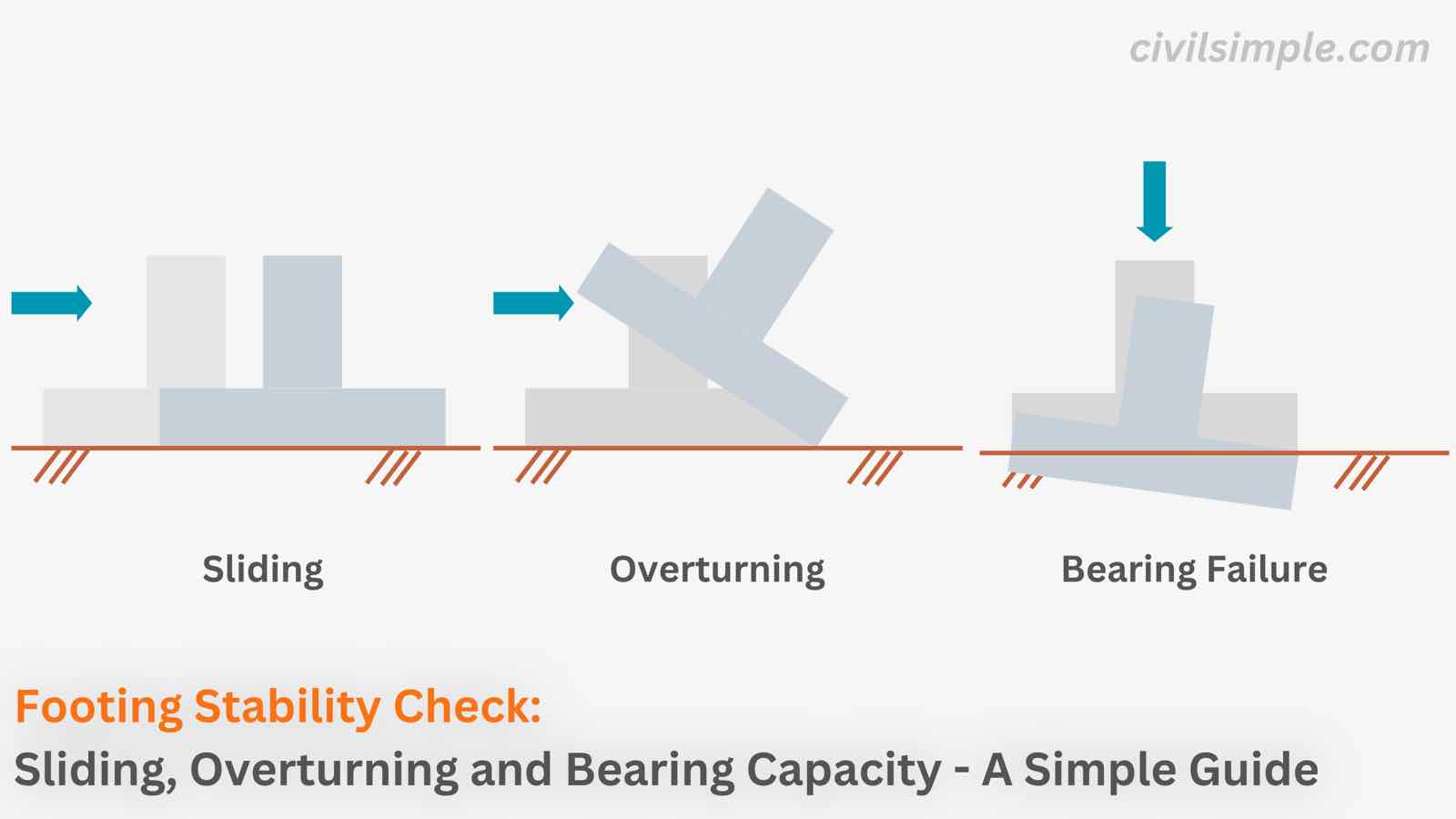
A pad footing spreads a column's load onto the soil. The concrete itself is rarely the problem — the ground is. Long before any material reaches its strength, a footing can fail in one of three ways:
- It can slide sideways when a horizontal force pushes it (sliding)
- It can tip over, rotating about the front edge of its base (overturning)
- The soil underneath can be overstressed and fail in shear or settle too much (bearing capacity)
These three are the stability checks of a footing. They are pure load-path geometry: they decide whether the footing stays where the structure needs it, and they run before — and independently of — the concrete and reinforcement design.
Where Do Stability Checks Apply?
Stability checks matter wherever horizontal forces or moments reach the ground:
- Retaining walls
- Crane and mast bases
- Portal frames with pinned bases
- Sign and lighting poles
- Any column footing with wind on the structure above
💡 Idea behind the Calculation
Factor of Safety (FOS)
Before calculating each check, you need to know the factor of safety (FOS). It is the margin of safety that the structure must satisfy, expressed as a ratio of resisting effects to disturbing effects.
Check 1: Sliding check
A horizontal force H at the base tries to drag the footing sideways. The only thing holding it back is friction between the concrete base and the soil — the vertical force V presses the base down, and friction resists sideways movement with μ × V.
- V : vertical (normal) force at the base
- H : horizontal (sliding) force
- μ : friction coefficient between the base and the soil
- FOSsliding : Factor of safety indicate from code, normally take 1.5
Typical friction coefficients between the base and the soil μ
| Interface | Typical μ |
|---|---|
| Concrete on clean gravel | 0.55 – 0.60 |
| Concrete on sand | 0.45 – 0.55 |
| Concrete on silty sand or silt | 0.30 – 0.40 |
| Concrete on clay | 0.25 – 0.35 |
Check 2: Overturning check
The horizontal force also acts at some height above the base, and together with any applied moment it tries to rotate the footing about its toe (the front edge of the base). The vertical load V fights back with its own lever arm.
- V : vertical (normal) force at the base
- H : horizontal (sliding) force
- h: distance of H to toe
- B/2: B = breath of footing, B/2 = distance between column to toe
- Moverturning : overturning moments from horizontal forces x their height above the base, plus any applied moments
- Mrestoring : Restoring moments from the vertical forces times their lever arms
- FOSoverturning : Factor of safety indicate from code, normally take 1.5
Check 3: Bearing capacity check
The vertical load and the moments are transferred to the soil as a pressure under the base. If the resultant vertical force passes exactly through the centre, the pressure is uniform. If a moment acts at the base, the pressure becomes a trapezoid — high at one edge, low at the other — and the soil must carry the maximum pressure without failing in shear or settling too much.
- V : vertical (normal) force at the base, including the footing's own weight
- M : moment at the base — the applied moment plus H × its height
- A : area of the footing base (B × L)
- I : second moment of area of the base about the bending axis (L × B³/12 for a rectangle)
- y : distance from the base centre to the edge (= B/2)
- qmax, qmin : the highest and lowest pressure under the base
- qallow : pressure the soil can take
📍 Quick Calculation Guideline
Given a pad footing with V, H (and its height above the base) and an applied moment M, determine whether it passes the stability checks
Gather the design forces at the base level
Collect V (vertical force), H (horizontal force) and any applied moment M — plus the footing size B × L and embedment depth.
Include the footing's own weight in V
Sliding check
FOS = μ × V / H ≥ 1.5.
Overturning check
Take moments about the toe: FOS = ΣMrestoring / ΣMoverturning ≥ 1.5.
Moverturning = H × h + M
Mrestoring = V x (B/2)
Bearing check — pressure
qmin = V/A − M × y / I > 0 — a negative value means part of the base lifts off
qmax = V/A + M × y / I ≤ qallow
qallow comes from the soil investigation or your design code.
Conclude
All three checks pass → the footing is stable; calculate the concrete and reinforcement next.
Any check fails → adjust the geometry (wider or deeper footing) and re-run the three checks.
⚠️ Common mistakes to avoid
- Taking moments about the wrong point — overturning moments are always about the toe, not the base centre
- Forgetting the height of the horizontal force — it is what turns a modest H into a big overturning moment
- Mixing factored and unfactored loads between checks — be consistent throughout
- Using the V/A ± M·y/I formulas when part of the base has lifted off (qmin < 0) — once tension appears, the pressure is no longer linear
- Counting passive pressure or a shear key that the construction detail does not actually provide
- Using one check's pass to skip the others — a footing that does not slide can still overturn, and one that neither slides nor overturns can still overstress the soil
📋 Key takeaways
- A pad footing has three stability checks: sliding, overturning and bearing capacity — it must pass all three.
- Sliding: FOS = μ·V/H ≥ 1.5 — friction at the base, helped by a key or passive pressure when needed.
- Overturning: FOS = ΣMrestoring/ΣMoverturning ≥ 1.5, taken about the toe.
- Bearing capacity: qmin = V/A − M·y/I > 0 and qmax = V/A + M·y/I ≤ qall.
🙋 Frequently asked questions
1. What is a footing stability check?
It is the set of three checks that confirm a pad footing will not slide sideways, will not overturn about its toe, and will not overstress the soil under its base. They are separate from the concrete and reinforcement design — a footing with perfectly sized reinforcement still fails if it slides or tips.
2. What is the difference between sliding and overturning?
Sliding is a rigid sideways movement of the whole footing — resisted by friction between the base and the soil. Overturning is a rotation about the toe — resisted by the restoring moment of the vertical load about that edge. Sliding is a force check; overturning is a moment check.
3. What factors of safety are used for footing stability?
Commonly used reference values are 1.5 for sliding, 1.5 for overturning and 3.0 for bearing capacity — but design codes express the same checks with their own partial factors, and the allowable bearing pressure always comes from the soil investigation. Use your code's values.
4. How do I calculate the bearing pressure under a footing?
Use the stress formula q = V/A ± M·y/I: the highest pressure qmax = V/A + M·y/I must stay ≤ qall, and the lowest pressure qmin = V/A − M·y/I must stay positive. A negative qmin means part of the base lifts off the soil — then the pressure is no longer linear and must be recalculated.
5. Which stability check usually governs?
It depends on the structure: sliding or overturning typically govern for tall, wind-dominated structures with large horizontal forces and narrow bases; bearing capacity governs on weak or variable soils. Because the governing check is not obvious in advance, all three are always run.
6. How can I fix a footing that fails a stability check?
For sliding: a shear key, deeper embedment (passive pressure) or a wider, heavier footing. For overturning: a wider base (bigger lever arm for V). For bearing: a larger base area, a deeper or stiffer bearing stratum, or ground improvement. Widening the footing helps all three at once.
📄 Need a footing stability check in your design report?
If you want a ready-to-submit design report with the sliding check, overturning check and bearing capacity check of your pad footing, feel free to try our application — what you need is just the design data values, and a ready-to-submit PDF report will be generated in a minute.

CivilSimple Team
The CivilSimple Team writes practical engineering guides for the profession and the curious. All articles are reviewed for technical accuracy before publication.