❓ Why Steel Section Properties Matter
Before designing structural steel, it helps to understand the following section properties and how each one affects a member's capacity and performance — so a better section can be selected.
This article covers briefly the essential properties to know, what they mean physically, and how they influence structural behavior.
1️⃣ Cross-sectional area, A
Cross sectional area is the section area of the steel member. It can be computed by simple geometry.
Common symbol in eurocode:
AEurocode2 AISC
| Section | Equation |
|---|---|
| Rectangle | |
| Circle | |
| I / H-section | |
| RHS | |
| CHS |
The Area will directly affecting:
🛡️ Tension/Compression Capacity
The relationship of A and axial capacity:
A larger area means more axial capacity — more material to carry tension or compression before yielding.
⚖️ Mass
The relationship of A and self-weight:
Mass is directly proportional to area — a bigger cross-section means more steel, and more weight to support.
💰 Cost
The relationship of A and material cost:
Since steel is typically priced by weight, a larger area generally means a higher material cost.
2️⃣ Second Moment of area, I
The second moment of area, (also called moment of inertia), measures a section's resistance to bending and its stiffness. It is a geometrical property of an area which reflects how its points are distributed with regard to an axis (y or z).
The Symbols of Second moment of area are a bit different across eurcodoe and AISC:
| Item | Eurocode | AISC |
|---|---|---|
| Second Moment of Area(Major) | ||
| Second Moment of Area(Minor) |
General Calculation of Second Moment of area of different shapes:
| Section | Equation |
|---|---|
| Rectangle | |
| Circle | |
| I / H-section | |
| RHS | |
| CHS |
The Second Moment of Area will directly affecting:
🛡️ Bending Stiffness
This bending stiffness is: EI.
A larger I means a stiffer section — it resists bending more for the same material.
〰️ Deflection
The relationship of I and deflection, δ :
Deflection is inversely related to I — doubling I roughly halves the deflection under the same load.
3️⃣ Elastic Section Modulus, S, Wel
The elastic section modulus relates the moment of inertia to the distance from the neutral axis to the extreme fiber of the section. The stress in section is experiencing linear distribution, as shown below.
The Symbols of Elastic Section Modulus are a bit different across eurcodoe and AISC:
| Item | Eurocode | AISC |
|---|---|---|
| Elastic Section Modulus(Major) | ||
| Elastic Section Modulus(Minor) |
General Calculation of Elastic Section Modulus of different shapes:
| Section | Equation |
|---|---|
| General | |
| Rectangle | |
| Circle | |
| I / H-section | |
| RHS | |
| CHS |
The elastic section modulus will directly affecting:
📐 Elastic moment capacity
The equation of elastic moment capacity is:
This is the moment at which the extreme fibre just reaches yield — the section is still fully elastic.
4️⃣ Plastic Section Modules, Z, Wpl
The plastic section modulus represents the section's capacity once it has fully yielded. The stress in section is experiencing redistribution of stress, as shown below.
The Symbols of Plastic Section Modules are a bit different across eurcodoe and AISC:
| Item | Eurocode | AISC |
|---|---|---|
| Plastic Section Modulus(Major) | ||
| Plastic Section Modulus(Minor) |
General Calculation of Plastic Section Modules of different shapes:
| Section | Equation |
|---|---|
| General | |
| Rectangle | |
| Circle | |
| I / H-section | |
| RHS | |
| CHS |
The plasic section modulus will directly affecting:
📐 Plastic moment capacity
The equation of plastic moment capacity is:
This is the moment at which the whole section has yielded — the maximum moment it can carry before forming a plastic hinge.
🔢 Example: how geometry affects section properties across three angle/section types
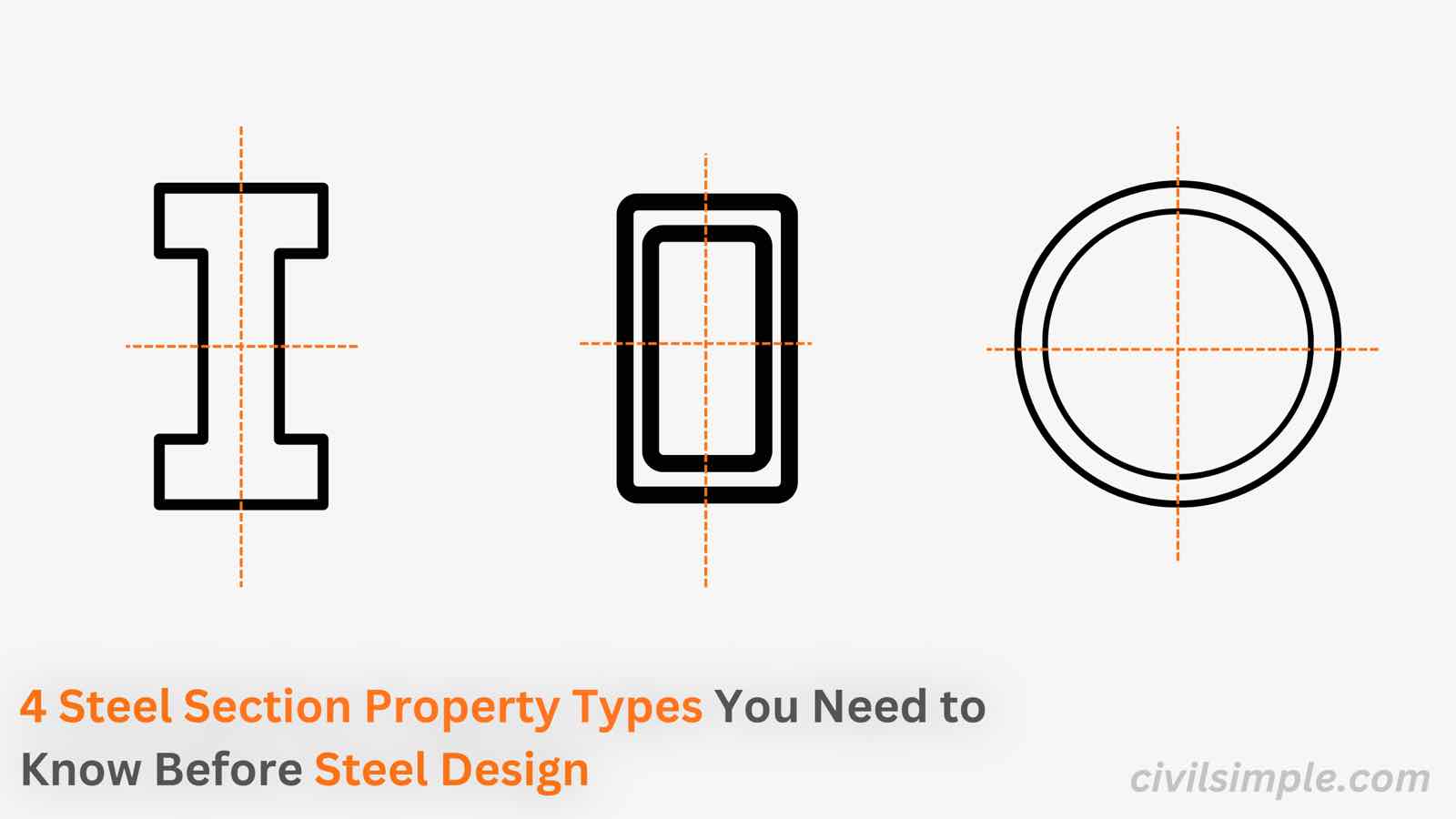
Since these properties are used directly to compute structural analysis and capacity, let's look at how different geometries (I-section, CHS, RHS) with similar area affect the properties, so we can make a better decision to suit the situation.
To illustrate how the geometry will affect the properties:
| I Section | RHS | CHS | which better | |
|---|---|---|---|---|
| Standard | 457x191x67 | 250x150x12.5 | 355.6x8.0 | (with similar area) |
| 8550 | 8700 | 8740 | similar | |
| 29400 | 6600 | 13200 | I section better | |
| 1450 | 3000 | 13200 | CHS better | |
| 1470 | 530 | 740 | I section better | |
| 150 | 400 | 740 | CHS better | |
| 1450 | 680 | 970 | I section better | |
| 240 | 480 | 970 | CHS better |
From the table above, we can see that even with the same area, different geometries produce very different value of the properties. Details of calculation of each value can be found in I-section , RHS and CHS
- I-section: is efficient at resisting moment in its main axis but is comparatively weak in the other axis.
- CHS: is more balanced in both directions.
- RHS: falls between the two — its properties are lower than the CHS's for the same area, but it's relatively easier to fabricate and connect.
So the right choice really depends on the structural situation at hand.
📄 Need to calculate the values of each section for I section, CHS or RHS?
If you want similar calculation analysis with your own steel section (also in I section/CHS/RHS), feel free to try our application, what you need is just the design data value, and a ready-to-submit design PDF report will be generated in a minute.

CivilSimple Team
The CivilSimple Team writes practical engineering guides for the profession and the curious. All articles are reviewed for technical accuracy before publication.