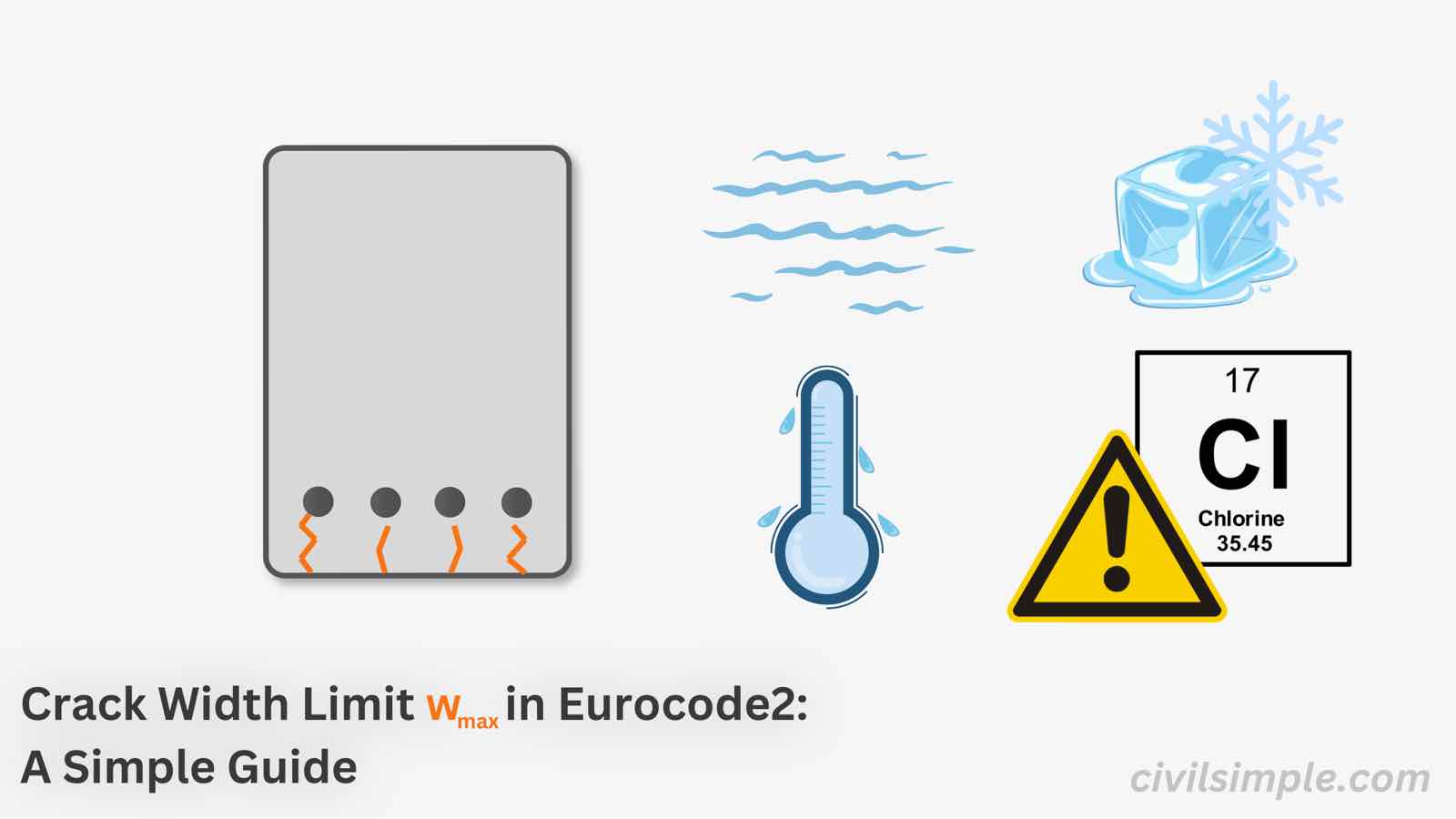
Why reinforced concrete crack?
Crack is common in reinforced concrete. Although concrete is strong in compression, it is weak in tension. When the tensile stress exceeds the concrete's tensile capacity, cracks begin to form.
Will the crack affect the performance of reinforced concrete?
In Ultimate Limit State (ULS) design, concrete in the tension zone is assumed to have cracked, and the reinforcing steel carries the tensile forces. Cracking is therefore expected in reinforced concrete.
Rather than preventing cracks completely, reinforced concrete design aims to control crack widths to satisfy durability, appearance, and serviceability requirements throughout the structure's design life.
Why is Crack Control Important?
Small cracks are generally harmless. However, excessive crack widths can lead to several problems:
- Water penetration
- Corrosion of reinforcing steel
- Reduced durability
- Poor appearance
- Increased maintenance costs
The purpose of crack control is not to eliminate cracking, but to limit the crack width to an acceptable value so the structure continues to perform as intended.
How Does Eurocode 2 Control Cracking?
Eurocode 2 treats crack control as a Serviceability Limit State (SLS) requirement. Crack control ensures that the structure remains durable and functional during normal service conditions.
Eurocode 2 Clause 7.3 provides methods for crack control, including:
- Minimum reinforcement requirements
- Bar spacing limitations
- Direct crack width calculation
The calculated characteristic crack width must be smaller than the allowable crack width .
wk = calculated characteristic crack width
wmax = allowable crack width specified by Eurocode 2
How is the Allowable Crack Width (wmax) Determined?
The allowable crack width is not a fixed value.
It depends mainly on:
- Exposure conditions
- Durability requirements
- Different country may also have additional own requirement to it
Eurocode 2 provides recommended crack width limits based on the exposure class.
Generally,
| Exposure Condition | Typical Crack Width Limit |
|---|---|
| Mild indoor environments | 0.4 mm |
| Moderate exposure | 0.3 mm |
The harsher the environment, the smaller the allowable crack width.
This reduces the likelihood of moisture and harmful substances (chlorides, carbonation, freeze/thaw cycling) reaching the reinforcement.
Step 1 – Determine the Exposure Class
The first step is to determine the exposure class of the structure.
Eurocode 2 refers to the exposure classes defined in Table 4.1, which describe the environmental conditions surrounding the concrete.
Typical examples include:
| Exposure Class | Typical Environment |
|---|---|
| X0 | Dry internal concrete with negligible corrosion risk |
| XC1–XC4 | Carbonation-induced corrosion |
| XD1–XD3 | Chloride exposure (excluding seawater) |
| XS1–XS3 | Marine environments |
| XF | Freeze–thaw exposure |
| XA | Chemical attack |
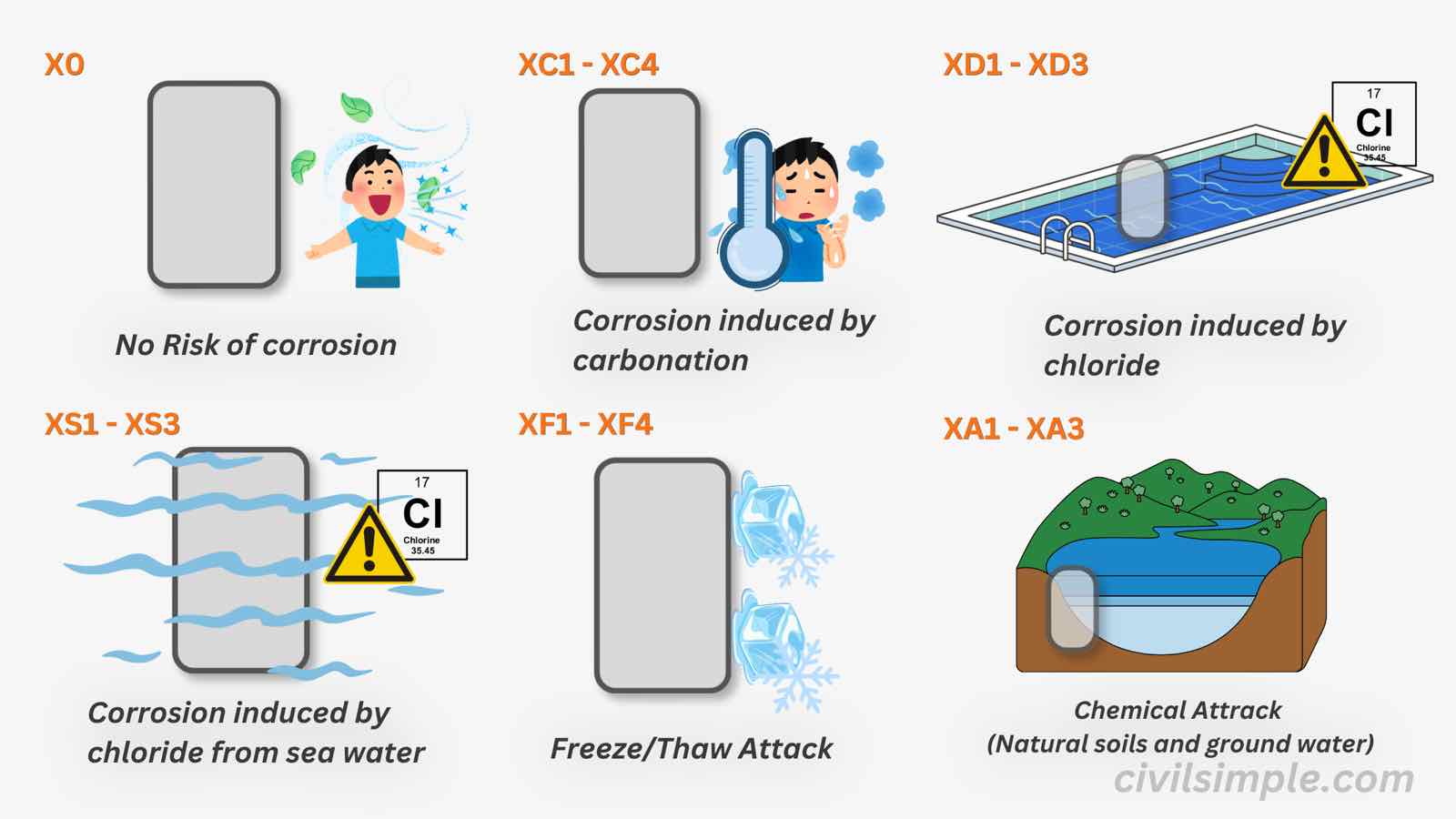
Details of each the exposure class can be seens in below:
Each exposure class reflects a different durability requirement.
Step 2 – Select the Recommended Crack Width Limit
Once the exposure class has been identified, Eurocode 2 Clause 7.1N recommends the maximum allowable crack width, where the used limits are:
| Exposure Class | Recommended Maximum Crack Width |
|---|---|
| X0 | 0.4 mm |
| XC1 | 0.4 mm |
| XC2, XC3, XC4 | 0.3 mm |
| XD, XS | 0.3 mm (or more stringent where required) |
For structures where watertightness or appearance is critical, designers may specify smaller crack width limits such as 0.2 mm or 0.1 mm.
What Happens Next?
After determining the allowable crack width, then we need to calculate the expected crack width of reinforced concrete section.
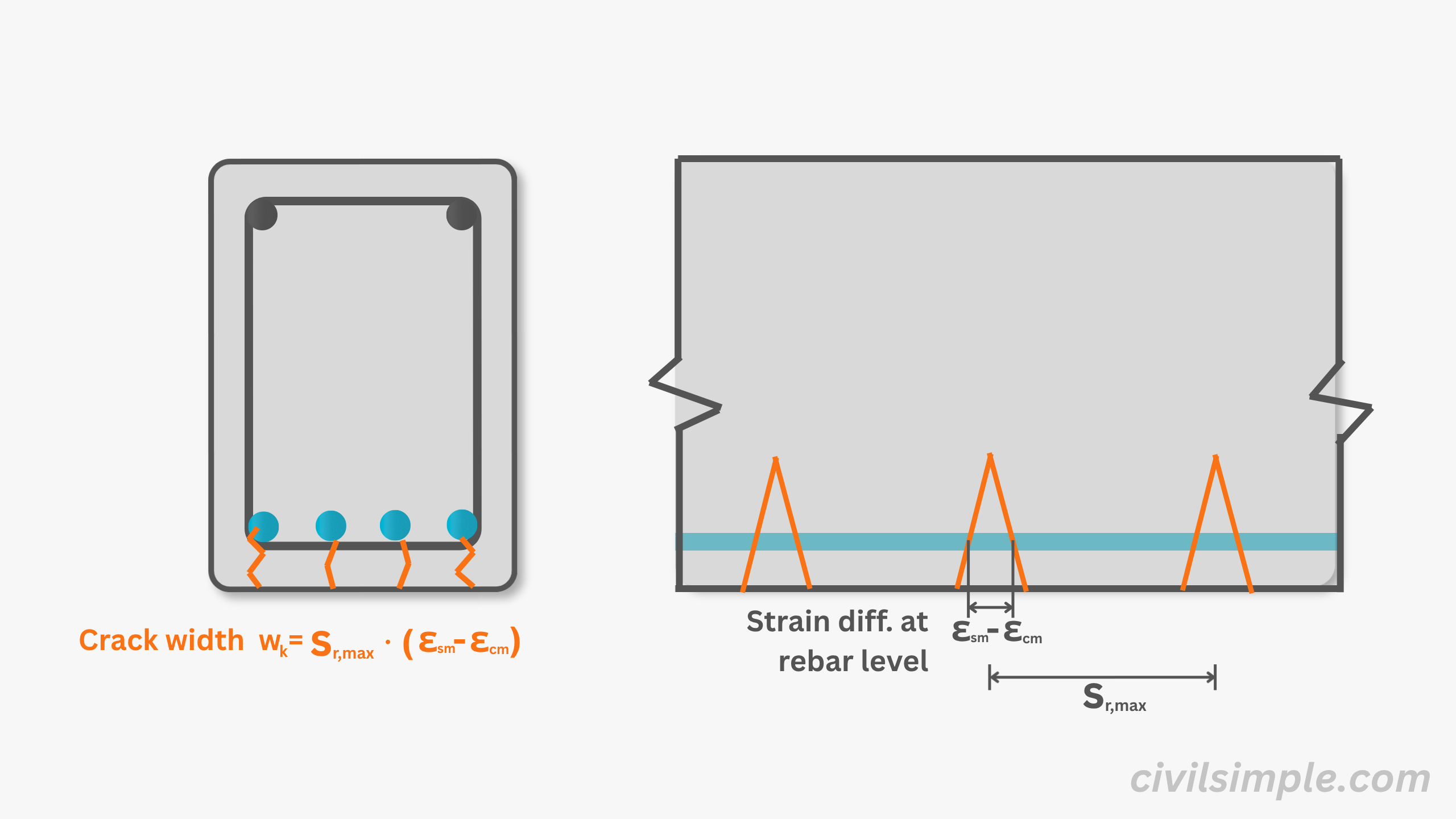
Details of calculation of crack width can be found in other articles such as the baisc idea and formula of crack width and also work example for calcualtion of crack width.
Summary & Key Takeaways
- Crack control is a Serviceability Limit State (SLS) check that limits crack widths to ensure the durability, appearance, and long-term performance of reinforced concrete structures.
- The allowable crack width (wmax) depends on the exposure class. More aggressive environments generally require smaller crack width limits to better protect the reinforcing steel from corrosion.
- The crack control process is: 1. determine the exposure class, 2. obtain the allowable crack width from Eurocode 2, 3.calculate the expected crack width, and 4.verify that it does not exceed the allowable limit.

CivilSimple Team
The CivilSimple Team writes practical engineering guides for the profession and the curious. All articles are reviewed for technical accuracy before publication.