❓ Why the way a section is made matters
Most engineers focus on a section's shape and size. But two sections with the same shape, area and material strength can behave differently — because how they were made leaves hidden effects locked inside the steel: residual stresses a changed yield strength and corner sharpness.
In Eurocode 3, in short, these effects raised from different steel section formation method will affect the choose of buckling curve (hence, the reduction factor) to be used in calcaultion of buckling resistance of the section.
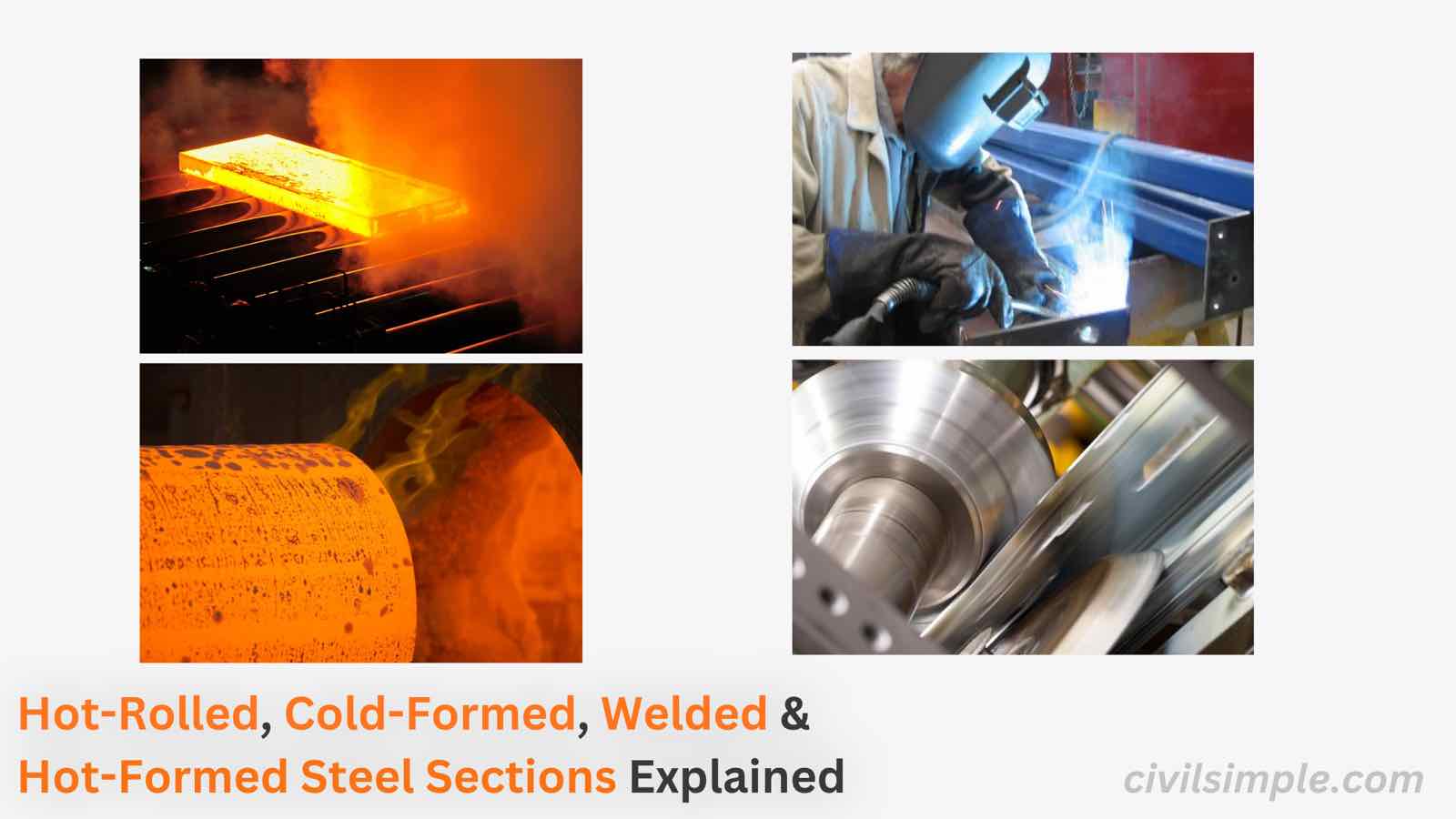
This article explains the four main ways steel sections are produced — hot-rolled, cold-formed, welded (built-up), and hot-formed / hot-finished — and how it affect the structural design calculations.
The way a steel section is made affects its buckling resistance.
The more unevenly the residual stresses are distributed, the weaker the section is against buckling, as some parts are relatively weaker.
🔢 The four ways steel sections are made
| Method | What happens | Typical products | Product standard |
|---|---|---|---|
| Hot-rolled | Steel is rolled into shape while red-hot | I/H sections, angles, channels, tees | EN 10025 |
| Welded (built-up) | Plates are cut and welded together | Welded I/H, plate girders, box girders | fabricated |
| Cold-formed | Thin sheet is bent to shape at room temperature | cold-formed RHS/CHS | EN 10219 |
| Hot-formed / hot-finished | Hollow section is hot-finished to relieve stress | Hot-finished RHS/SHS/CHS | EN 10210 |
1️⃣ Hot-rolled sections (I and H Section)
Hot-rolled sections are formed by passing a heated steel billet (≈1200°C, well above the recrystallisation temperature) through a series of rolling mills that progressively squeeze it into the final shape.
Because the steel is soft and ductile at that temperature, the section forms with smooth, radiused corners and a uniform grain structure, and it develops only moderate residual stresses from later uneven cooling.
Details of the fabriation can be found in this video: Steelmaking: Rolling
The hot-rolled section affects design as below:
📈 Buckling behaviour
The modest residual stresses give a favourable buckling curve — typically curve a about the strong axis and curve b about the weak axis for a hot-rolled I-section.
📐 Corners & tolerances
Radiused corners and controlled mill tolerances — the section properties in the published tables can be used directly.
📦 Available sizes
Limited to the standard mill-roll catalogue — you cannot order an arbitrary custom hot-rolled shape.
2️⃣ Welded (built-up) sections (I and H Section)
Welded sections are fabricated by cutting plates and welding them together — most commonly into welded I/H-sections or deep plate girders.
The key differences from a hot-rolled section are:
- Sharp corners (no rolling radius) — the web meets the flange at a right angle.
- The welding heat leaves large residual stresses: high tensile stress at the welds (often up to fy), balanced by larger compressive stress in the flange tips and web.
- Flexible in sharp - Not limited by mill rolls, can fabricate any size, with thicker webs for deep girders.
The welded steel section may affect design as below:
📈 Buckling behaviour
The large residual stresses and sharp corners put welded I-sections onto the lower buckling curves — curve b/c about the strong axis and curve c/d about the weak axis — clearly worse than the a/b of an equivalent hot-rolled section.
📐 Plate girders
For deep, slender webs, EN 1993-1-5 governs web buckling, shear with tension-field action, and stiffener design.
🔁 Fatigue
The welds are fatigue details — for dynamically loaded members (bridges, cranes) check EN 1993-1-9.
📦 Freedom of size
Because it is built from plate, a welded section can be made to any depth/flange combination a hot-rolled catalogue cannot supply.
3️⃣ Cold-formed sections (Hollow Section or Open Profile)
Cold-formed sections are made by bending or roll-forming thin steel sheet or strip at room temperature into lightweight open profiles (channels, Z, Σ) or hollow sections.
Details of the fabriation can be found in this video: Visit Germany's Leading Steel Mill
Bending the steel cold does two important things:
- It creates uneven residual stresses across the section.
- It strain-hardens the corners (where the bending is most severe), raising the yield strength there.
Because of the cold work, the average yield strength fya of the finished section is higher than the basic yield fyb of the parent strip. EN 1993-1-3 lets you use this raised value, detail will be discussed in another article:
The cold-formed steel section may affects design as below:
🛡️ Using the raised fya
The increased fya may be used for tension resistance, and for compression / bending only when the section is fully effective (Aeff = Ag). For slender sections the benefit is lost.
📈 Buckling behaviour
Bending residual stresses through the wall thickness, plus thin plates, push cold-formed sections onto the lower buckling curve c.
4️⃣ Hot-formed / hot-finished sections (Hollow Section. or open Profile)
This applies mainly to hollow sections. A section may first be cold-formed and then hot-finished (normalised) to relieve the forming stresses, or produced seamless / hot-formed directly.
Details of fabriation can be found in videos such as: hot-finished and Hot Extrusion .
The result is low residual stresses, uniform properties, and good ductility and toughness right through the corners.
The distinction that matters in design is EN 10210 (hot-finished) versus EN 10219 (cold-formed) hollow sections.
📈 Buckling curve
Hot-finished hollow sections sit on buckling curve a0 — the most favourable of all. With low residual stress the section behaves close to the ideal column.
⚖️ Same shape, different curve
A cold-formed hollow section of the same shape sits on curve c. So for a moderate slenderness, hot-finished gives a noticeably higher buckling resistance.
🛡️ Ductility & toughness
Normalising restores ductility at the corners, so hot-finished sections are preferred where plastic rotation or seismic ductility is required.
Hot-finished hollow sections use buckling curve a0; cold-formed hollow sections of the same shape use curve c. The entire difference is the residual stress left behind by how they were made.
🔎 Compare their difference: residual stress and the buckling curve
The biggest design consequence of the manufacturing method is residual stress.
Residual stresses are self-balanced stresses locked into the section from uneven cooling (hot-rolled), welding heat (welded), or cold bending (cold-formed). They add to — or subtract from — the stress caused by the applied load, so a section that already carries compressive residual stress reaches yield earlier under load and buckles at a lower force.
Flexural buckling resistance (N b,Rd)
In EN 1993-1-1, this is captured by the imperfection factor α and the buckling curve (a0, a, b, c, d) assigned to each section type. A larger residual stress / imperfection means a lower curve, a lower reduction factor χ, and a lower buckling resistance:
The five buckling curves and reduction factor
Which curve you use depends on the section type and the buckling axis. The table below summarises the most common cases (EN 1993-1-1, Table 6.5):
| Section (manufacturing) | y–y (strong axis) | z–z (weak axis) |
|---|---|---|
| Hot-rolled I/H, h/b > 1.2, t_f ≤ 40 | a | b |
| Welded I/H, h/b > 1.2, t_f ≤ 40 | c | d |
| Hot-finished hollow (EN 10210) | a0 | a0 |
| Cold-formed hollow (EN 10219) | c | c |
| Cold-formed open (lipped C, Z) | c | c |
In Eurocode 3, it defines five buckling curves — a0, a, b, c, d — each with its own imperfection factor α: EN 1993-1-1, Cl.6.3.1.2
| Buckling curve | Imperfection factor |
|---|---|
The reduction factor χ is obtained from:
🧮 What this means for your calculations
1. Pick the right buckling curve for calculating buckling resistance
Check how the section was made before using Table 6.5. Using the wrong curve can overestimate buckling resistance.
2. Use the raised fya only when fully effective
The cold-forming bonus fya applies to compression/bending only when Aeff = Ag. For a slender section, use the basic fyb.
3. Check fatigue for welded members
Welded built-up members under variable load need a fatigue check to EN 1993-1-9 — the welds are the critical details.
📄 Want a ready-to-submit steel design report?
If you want a ready-to-submit design report that runs the section classification and buckling checks with your own steel section, feel free to try our application — you just enter the design data, and a ready-to-submit PDF report is generated in a minute.
References
- Eurocode 3: Design of steel structures — Part 1-1: General rules and rules for buildings (EN 1993-1-1) — ·2005
- Eurocode 3: Design of steel structures — Part 1-3: General rules - Supplementary rules for cold-formed members and sheeting (EN 1993-1-3) — ·2006
- Eurocode 3: Design of steel structures — Part 1-5: Plated structural elements (EN 1993-1-5) — ·2006

CivilSimple Team
The CivilSimple Team writes practical engineering guides for the profession and the curious. All articles are reviewed for technical accuracy before publication.