❓ What is Effective Class 2 Web?
Effective Class 2 Web is a bending resistance enhancement intoruced in Eurocode 3 for steel I section, where the flange is classified as Class 1 or 2 while the web is considered as Class 3. Details about section classification, please found in previous article.
Since section classification considering individual plate's class and take the worst case for calculation. While normally in this case, the section is classified as Class 3, the corresponding bending resistance will be calcualted based on elastic modulus Wel, which the different in capacity may be typically 10-15% between Wpl and Wel.
However, as the flange can be perfectly plastic (Class 1 or 2) but whose web just identified into Class 3 — such as a welded girder with a deep thin web, or a hot-rolled. It will be a waste in the bending resitance. Therefore, Eurocode 3 has a specific clause for this case: effective Class 2 cross-section and effective plastic modulus.
Common symbol in eurocode:
Aeff & Wpl,effEN 1993-1-1 Cl.6.2.2.4(1)
flowchart TD
  A("Classify flanges and web") --> B{"Web <b>Class 3</b>?"}
  B -- no --> R("Use W<sub>pl</sub> or W<sub>el</sub> as classified")
  B -- yes --> C{"Flanges <b>Class 1 or 2</b>?"}
  C -- no --> D("<b>Class 3</b> → elastic W<sub>el</sub>")
  C -- yes --> E("<b>Effective Class 2</b> (Cl. 5.5.2(11))")
  E --> G("W<sub>pl,eff</sub>  → M<sub>pl,eff,Rd</sub>")
Decision Logic of Effective Class 2
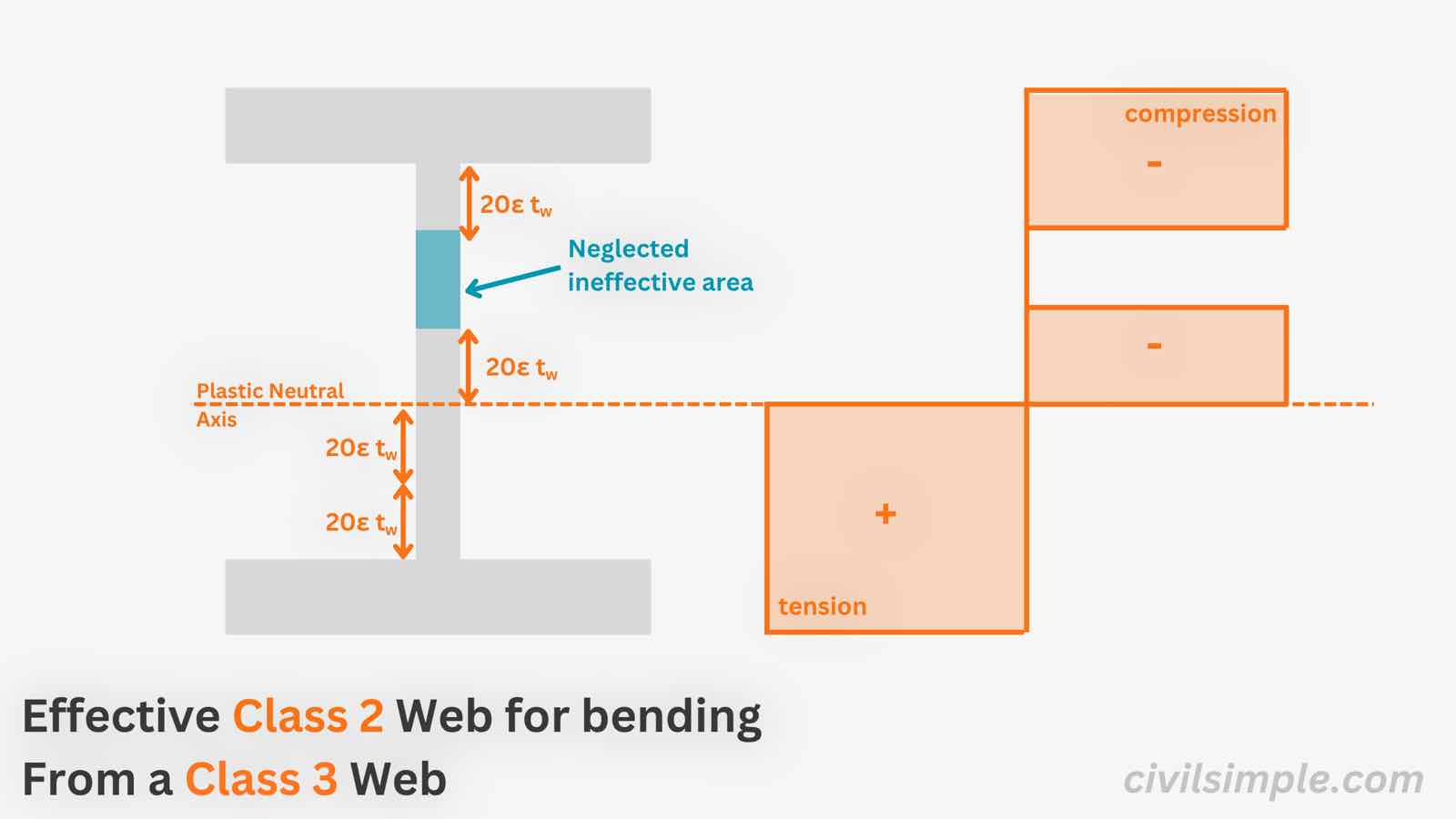
📐 The effective web — 20ε·tw and neglected ineffective web
The rule is purely geometrical introduced by Eurocode 3EN 1993-1-1 Cl.6.3.
With use of class 2 effective web, the web in compression are divided into 3 parts as below (also shown in diagram):
- top 20ε·tw from the compression flange
- middle neglectable web area between two 20ε·tw stripes
- bottom 20ε·tw from the plastic neutral axis
where ε is the grade factor:
🛡️ Formulas for Effective Plastic Modulus, Wpl,eff
To calcualte the effective plastic modulus:
1. first calcualted the shifted plastic neutral axis (due to neglected area) by equaling compression and tension area (the web length below plastic Nautral axis is 2 * 20 εtw).
2. Then calculate the corresponding plastic modulus
hence the bending moment resistance. EN 1993-1-1 Cl.6.2.2.4(1)
🛡️ The bending resistance of Effective Class 2 Section
With Wpl,eff in hand, the bending resistance is the ordinary plastic formula — just with the effective modulus:
For a section with a Class 3 web and Class 1/2 flanges, it now have two possible bending resistances:
| Approach | Modulus | Bending resistance | Note |
|---|---|---|---|
| Elastic Class 3 | safe default — no plastic capacity | ||
| Effective Class 2 (Cl.5.5.2(11)) | recovers most of Wpl |
Since Wpl,eff > Wel, the effective Class 2 method typically recovers 80–95% of the gap between the elastic and plastic bending resistance. Details worked example can be found in Work Example of Bending Resistance of Effective Class 2 Web for a Steel I-Section (Eurocode 3)
🏗️ Why the neglected part give better section?
In a plastic stress block the web's contribution to the moment is very less — the flanges, far from the neutral axis, provided more. And the strip you discard sits in the middle of the compression zone, next to the neutral axis, where the lever arm is small.
So by removing part of the compression web strip, Wpl,eff ends up close to the full Wpl — it recover almost all of the plastic capacity, paying only a small fraction for the web's slenderness.
📝Summary & Key Takeaways
- Effective Class 2 is a bending resistance enhancement concept.
- It can be used when an I-section has Class 1 or 2 flanges but a Class 3 web.
- By neglecting part of the web, an effective plastic modulus can be used to calculate the moment resistance instead of the elastic modulus, which typically enhances bending resistance by 5–15% for the same section.
📄 Want a ready-to-submit steel design report?
If you want a ready-to-submit design report that runs the section classification, the effective Class 2 check, and the bending and buckling resistance with your own steel section, feel free to try our application — you just enter the design data, and a ready-to-submit PDF report is generated in a minute.
References
- Eurocode 3: Design of steel structures — Part 1-1: General rules and rules for buildings (EN 1993-1-1) — ·2005
- DESIGNERS’ GUIDE TO EN 1993-1-1 EUROCODE 3: DESIGN OF STEEL STRUCTURES — ·2005

CivilSimple Team
The CivilSimple Team writes practical engineering guides for the profession and the curious. All articles are reviewed for technical accuracy before publication.