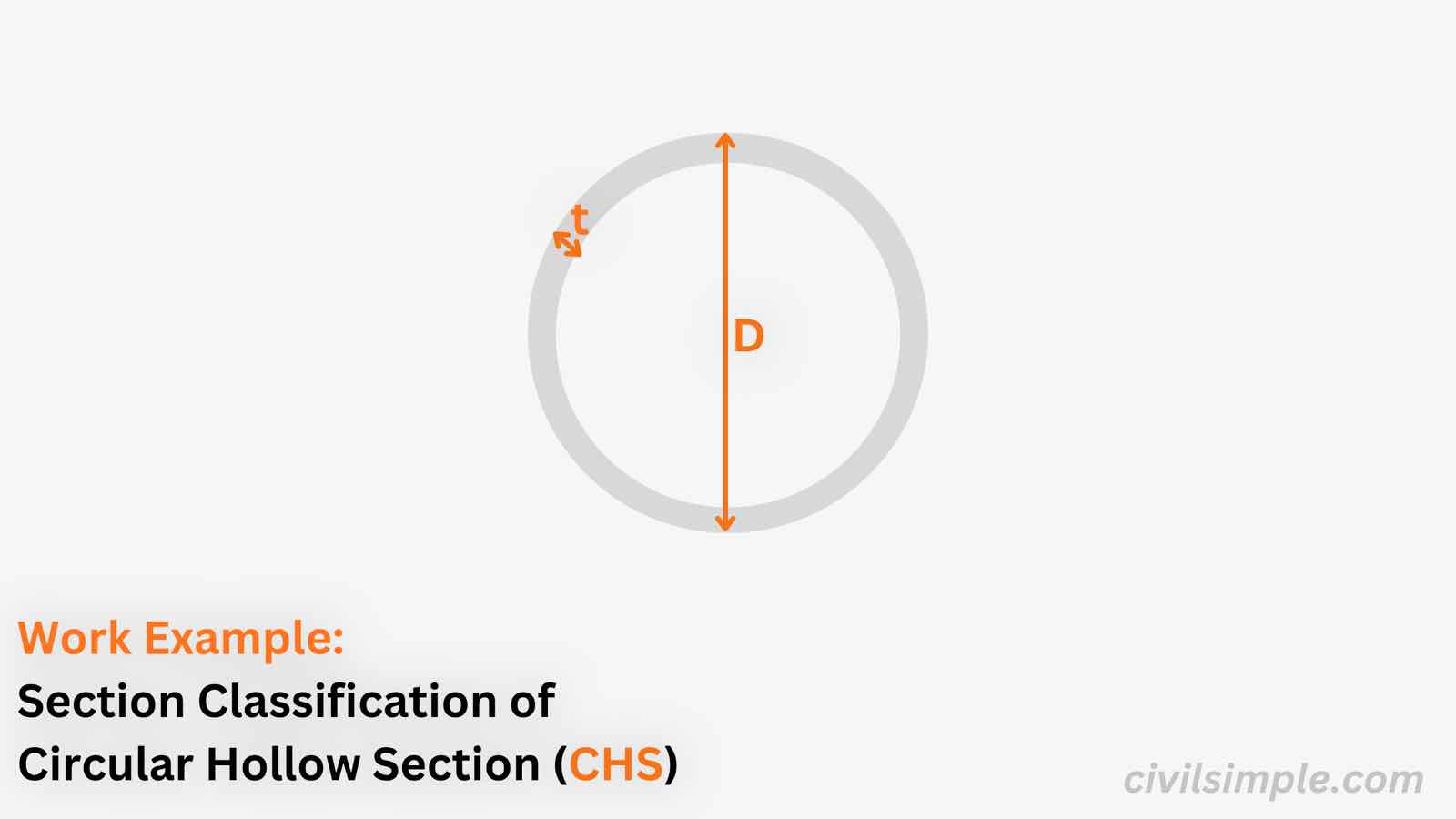
Work Example of Section Classification of CHS in Bending and Compression
A worked example classifying a Circular Hollow Section (CHS) under both pure bending and pure compression — a single D/t check that gives the same class (Class 2) under both stress states.
CivilSimple Team
Published Aug 20, 2026
8 min read
Figure 1 — Work Example of Section Classification of CHS in Bending and Compression
👋 Introduction
Section classification decides how much of a section's strength we are allowed to use in design. For a CHS, there is only one check — the D/t ratio — because the tube has no flat plate elements and no separate flange and web. Importantly, the D/t limits are the same in bending and compression, so a CHS falls into the same class regardless of the stress distribution — unlike I-sections and RHS, where the web's limits depend on whether it is in bending or uniform compression. In this article we classify the same CHS (355.6x8.0) under both pure bending and pure compression (both give Class 2).
ℹ️ Class Naming Difference between Eurocode 3, IS 800 and AISC
The classification concept is the same worldwide, but the class names and the limiting ratios differ slightly between codes:
Design Capability
Eurocode 3
IS 800
AISC 360
Plastic design (full hinge rotation)
Class 1
Plastic
Compact
Full plastic moment, limited rotation
Class 2
Compact
Compact
Elastic capacity (yield at extreme fibre)
Class 3
Semi-compact
Noncompact
Elastic with reduced (effective) section
Class 4
Slender
Slender
Note that the material factor ε also uses a different constant: EN 1993-1-1 uses ε = √(235/fy), while IS 800 uses ε = √(250/fy).
📐 Design Data
Below are the design information of the CHS (355.6x8.0), which we will check under both pure bending and pure compression.
Steel Section
Type
CHS
Standard
355.6x8.0
Diameter, D
356mm
Thickness, t
8.0mm
Material
Steel Grade
S355
Yield Strength, fy
355 N/mm²
🔢 Calculation Steps
*Below is using Eurocode symbols and limits Table 5.2, EN 1993-1-1. For IS 800, use ε = √(250/fy) and the limits in its Table 2.
Common check (the single D/t ratio)
For CHS, classification is based on a single D/t ratio, and the limits are the same in bending and compression — so this check is computed once and applies to both stress states.
For CHS, the D/t limits are identical in bending and compression, so the section class is unchanged (Class 2) under both — unlike I-sections and RHS, where the web's limits tighten under uniform compression and can drop the section into a lower class.
📄 Need a Full Design Check Report?
If you want a similar classification check with your own design data, feel free to try our application, what you need is just the design data value, and a ready-to-submit design PDF report will be generated in a minute.
The ready-to-submit PDF Report is not generated by AI but programmed by chartered engineer, which is accurate, no hallucination and same input same output.
The CivilSimple Team writes practical engineering guides for the profession and the curious. All articles are reviewed for technical accuracy before publication.