Work Example: Pad Footing Stability Check — Sliding, Overturning and Bearing
A complete worked example of the three pad footing stability checks — a 3.0 m × 3.0 m × 1.5 m footing under dead and live loads: the self weight, the bearing stress, the sliding and overturning factors of safety and the final utilisation ratios.
CivilSimple Team
Published Nov 27, 2026
11 min read
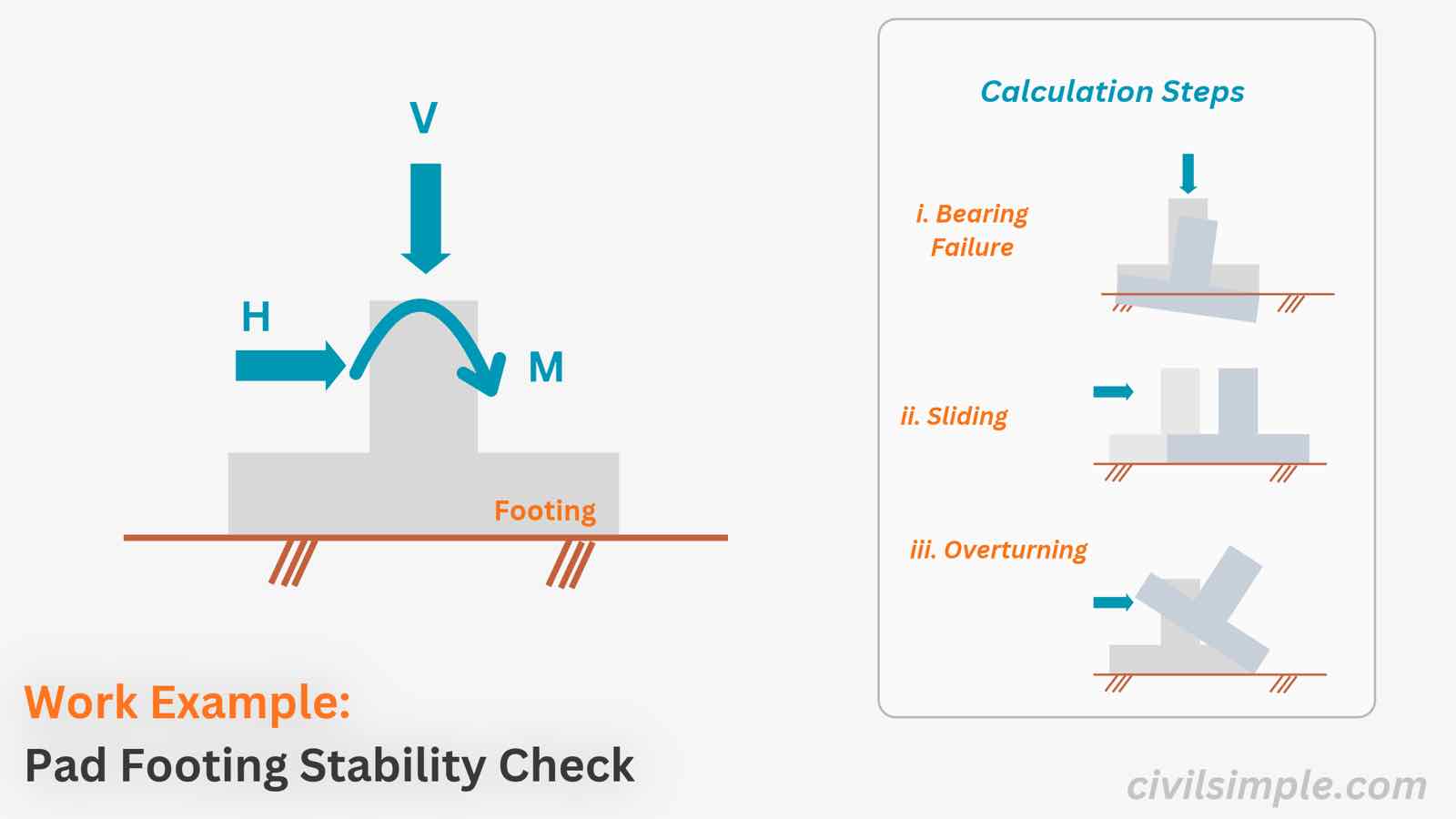
Figure 1 — A worked example - the 3.0 m x 3.0 m x 1.5 m footing passes all three stability checks, with sliding governing at a utilisation of 72%.
👋 Introduction
A pad footing must pass three stability checks before any concrete or reinforcement is designed:
Bearing capacity: the soil under the base must not be overstressed by the pressure the footing transfers to it.
Sliding: the footing must not be dragged sideways by the horizontal force.
Overturning: the footing must not tip about its toe under the horizontal force and the applied moment.
This work example runs all three checks for a 3.0 m × 3.0 m pad footing, 1.5 m deep, carrying a vertical force Fx = 20 + 5 kN, a horizontal force Fy = 50 + 10 kN and an applied moment My = 50 + 50 kNm (dead / live), in the same order a calculation report runs them:
Bearing stress check — the base geometry, the applied axial force and moment, the self weight, and the maximum and minimum pressure under the base
Sliding check — the sliding force, the self weight, the friction resistance and the factor of safety
Overturning check — the self weight, the resistance moment, the overturning moment and the factor of safety
The three checks are independent a footing that does not slide can still overturn, and one that neither slides nor overturns can still overstress the soil so all three are always run. Each check below carries its own factor of safety, applied to the service level (unfactored) loads.
📐 Design Data
Below is the design information of the pad footing, which we will check under the vertical force, the horizontal force and the applied moment.
Pad Footing
Type
Pad footing (concrete)
Length, L
3.0 m
Width, W
3.0 m
Depth, D
1.5 m
Design Loads
Vertical Force, Fx (Dead / Live)
20 kN / 5 kN
Horizontal Force, Fy (Dead / Live)
50 kN / 10 kN
Applied Moment, My (Dead / Live)
50 kNm / 50 kNm
Soil and Safety Factors
Allowable Bearing Pressure, qallow
250 kPa
Friction Coefficient, μ
0.35
Factor of Safety, Sliding
1.5
Factor of Safety, Overturning
1.5
Material
Concrete Density, ρ
25 kN/m³
Load Combination (SLS)
Dead Load Factor, fDL
1.0
Live Load Factor, fLL
1.0
🔢 Calculation Steps
*The checks below follow the code-neutral factor-of-safety practice of the stability check guide.
1.Bearing Stress Check
Area
=
=
=
Moment Inertia
=
=
=
Distance From N.A.
=
=
=
Applied Axial Force
=
=
=
Applied Moment
=
=
=
Volume
=
=
=
Self Weight
=
=
=
Stress
=
=
=
Max. Bearing Stress
=
=
=
Since the minimum bearing stress δmin = 18.1 kPa > 0, the checking of the minimum bearing stress passes.
∴ The section is sufficient for Bearing Capacity.
2.Sliding Check
Sliding Force
=
=
=
Volume
=
=
=
Self Weight
=
=
=
Resistance Force
=
=
=
Sliding Check
=
=
=
∴ The section is sufficient for Sliding.
3.Overturning Check
Volume
=
=
=
Self Weight
=
=
=
Combine Fx
=
=
=
Resistance Moment
=
=
=
Combine F_y
=
=
=
Combine M_y
=
=
=
Overturning Moment
=
=
=
Overturning Check
=
=
=
∴ The section is sufficient for Overturning.
📋 Summary of Pad Footing Stability
Checking Item
Current
Allowable
Utilization
Pass?
Bearing Stress Check
62.5 kPa
250 kPa
25%
Pass
Min Bearing Stress Check
18.1 kPa
> 0
N/A
Pass
Sliding Check
2.09
1.5
72%
Pass
Overturning Check
2.86
1.5
52%
Pass
Overall
Pass
The values above are the exact results of the calculation; the PDF report of the application rounds them for display (self weight 338 kN, bearing stress 62 kPa and 18 kPa), which changes none of the utilisations.
🙋 Frequently asked questions
1. What is a pad footing stability check?
It is the set of three checks that confirm a pad footing will not slide sideways, will not overturn about its toe, and will not overstress the soil under its base. They are independent of the concrete and reinforcement design — a footing with perfectly sized reinforcement still fails if it slides or tips. Here all three are run on the same footing: 62.5 kPa against the 250 kPa allowed, a sliding factor of safety of 2.09 and an overturning factor of safety of 2.86.
2. Why are service (unfactored) loads used for the stability checks?
All three checks here run on the service level combination (1.0 × dead + 1.0 × live), because they are stability checks with a factor of safety applied to the result — and the allowable bearing pressure from the soil investigation is itself a service level value. Some design codes work with factored ULS loads against a design bearing resistance instead; check which convention your code uses and use it consistently throughout the report.
3. Why is the live vertical load left out of the sliding resistance?
Because it is not always there — the most onerous moment for sliding is when the horizontal force acts but the live load is absent, leaving only the dead load and the self weight to create friction. Counting the live load would overestimate the resistance. Here that means the resistance is (20 + 337.5) × 0.35 = 125 kN, not a larger number.
4. Which stability check governs this footing?
The sliding check, at a utilisation of 72%. Its resistance is friction only 125 kN against the 60 kN horizontal force while the overturning check has a wide margin, because the 3.0 m base gives a long restoring lever arm, and the bearing check has a large margin because 9 m² of base carries 362.5 kN. Deepening the footing is what helps sliding most, since it adds self weight pressing the base down.
5. Why must the minimum bearing stress stay positive?
Because the moment can push the pressure so hard onto one edge that the other edge lifts off the soil, giving a negative minimum stress. Once tension appears under the base the linear stress formula no longer applies and the pressure has to be recalculated on the reduced contact area. Here the minimum stress is 18.1 kPa, so the base is fully in compression — the same statement as the middle third rule, e = M/N = 0.28 m ≤ B/6 = 0.5 m.
6. Can I reuse this example for my own footing?
Yes. The stability check guide collects the formulas and the quick calculation guideline. Change the dimensions, the loads and the soil values, then repeat the same order of checks — bearing stress → sliding → overturning. Each of the three checks is also worked out on its own in the bearing stress, sliding and overturning work examples.
📄 Need a Pad Footing Stability Check in Your Design Report?
If you want a ready-to-submit design report with the bearing stress check, sliding check and overturning check of your pad footing, feel free to try our application — what you need is just the design data values, and a ready-to-submit PDF report will be generated in a minute.
The ready-to-submit PDF Report is not generated by AI but programmed by chartered engineer, which is accurate, no hallucination and same input same output.
Eurocode — Basis of structural design (EN 1990)—CEN (European Committee for Standardization)·2002
CivilSimple Team
The CivilSimple Team writes practical engineering guides for the profession and the curious. All articles are reviewed for technical accuracy before publication.