Previously, we discussed what buckling is and why slender members fail long before the steel itself yields, and how to check flexural buckling of columns.
This article focuses on how to check another buckling mode — Lateral Torsional Buckling (LTB) for beams, based on Cl. 6.3.2 in Eurocode 3 (EN 1993-1-1).
❓ What is lateral torsional buckling?
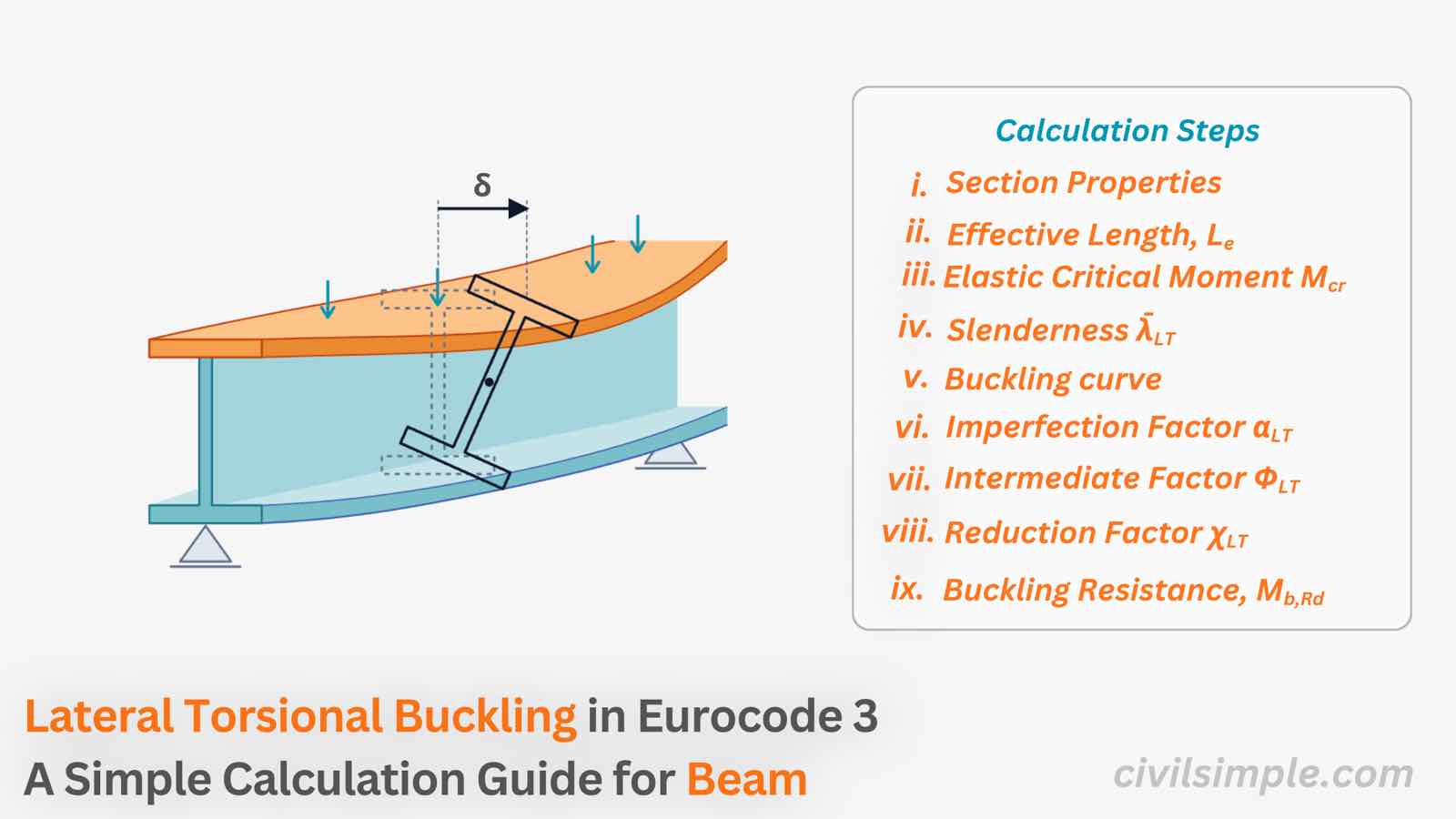
Lateral torsional buckling is the most common buckling mode for beams, which a slender beam is bent about its major axis, the compression flange .
As it cannot bow in the plane of the web because the web supports it, it
- (1) moves sideways and
- (2) twists at the same time.
✔️Only check the major axis
For lateral torsional buckling check, it only concerns bending about the major axis (y-y), unlike flexural buckling, where both axes are checked,
⏩ LTB can also be ignored when:
- The compression flange is fully restrained against lateral movement (e.g., by a concrete slab or closely spaced bracing) and twist is prevented.
- The section is not susceptible to LTB, such as circular or square hollow sections (CHS/SHS), which have very high torsional stiffness.
🔑 The key parameter: Mcr
Mcr is the moment at which a perfect, elastic beam would buckle laterally. It is the beam version of the Euler load Ncr in the flexural buckling check.
For a doubly symmetric section, loaded at the shear centre, a commonly used form is:
π²EIz / L² = sideways bending stiffness from Euler load of the compression
√( Iw/Iz + L²GIt / π²EIz) = torsional resistance = warping stiffness (Iw) + St Venant torsional stiffness (It)
C1 = A factor for the shape of the bending moment diagram, for conversative case, take 1.0
Eurocode 3 does not give a formula for Mcr. It is normally calculated from published non-contradictory guidance such as NCCI SN003 (Access Steel),
💡 The Idea Behind the Calculation
The lateral torsional buckling check in Eurocode 3 follows the same logic as the flexural buckling check — but in terms of bending moment instead of axial force. It determines how much of a beam's full bending capacity remains available once lateral torsional buckling is taken into account.
This capacity depends on five main factors:
- Unrestrained length (L)
- Section geometry: Torsional and Wrapping StiffnessIw, IT.
- Material: the steel's stiffness (E, G) and its yield strength (fy).
- Moment diagram shape (C1)
- Imperfections (αLT)
Then, these factors are converted into three key values:
- Elastic critical moment (Mcr)
- Non-dimensional slenderness ( ): = √( Wy · fy / Mcr )
- Reduction factor (χLT)
The reduction factor is applied to the section's bending capacity to get the design buckling resistance moment (Mb,Rd). This is then compared with the design bending moment (MEd):
🆚 Two methods in Eurocode 3: the special case and the general case
Eurocode 3 gives two ways to calculate χLT. They share the same workflow (Mcr → λ̄LT → curve → χLT) but use different parameters and curve tables:
Comparsion of the special case and the general case for χLT
| Parameter | General case (Cl. 6.3.2.2) | Special case (Cl. 6.3.2.3) |
|---|---|---|
| Applies to | Rolled sections, equivalent welded sections and other sections in bending | Rolled sections and equivalent welded sections |
| λ̄LT,0 (plateau length) | 0.2 (max.) | 0.4 (max.) |
| β (curve shape) | 1.0 | 0.75 (min.) |
| Buckling curve table | EN 1993-1-1 Table 6.4 | EN 1993-1-1 Table 6.5 |
| Extra limit | χLT ≤ 1.0 and χLT ≤ 1/λ̄LT² | χLT ≤ 1.0 and χLT ≤ 1/λ̄LT² |
| Optional refinement | — | Moment diagram modification factor f |
| Result | More conservative | Less conservative, better matched to real tests |
For a typical rolled I or H beam, the special case is the one normally used. It gives a more economical result because it has a longer plateau (λ̄LT,0 = 0.4) and a less steep curve (β = 0.75), and it can be refined further with the factor f.
📖 Glossary: parameters in the buckling resistance calculation
As many parameters are involved in the calculation, the glossary below lists each one with a short explanation. The step-by-step calculation guide follows right after it.
Common Glossary for Lateral Torsional Buckling Resistance Calculation
| Symbol | Name | Simple meaning |
|---|---|---|
| MEd | Design bending moment | The factored moment about the major axis that the beam must carry |
| Mb,Rd | Design buckling resistance moment | The maximum moment the beam can safely resist, considering LTB |
| Mcr | Elastic critical moment | The theoretical moment at which a perfect beam would buckle laterally |
| Wy | Section modulus (major axis) | Wpl,y for Class 1–2, Wel,y for Class 3, Weff,y for Class 4 |
| fy | Yield strength | Steel strength, e.g. 275 or 355 MPa |
| E | Young's modulus | Steel stiffness, 210,000 MPa |
| G | Shear modulus | Steel shear stiffness, ≈ 81,000 MPa |
| Iz | Second moment of area (minor axis) | Sideways bending stiffness of the section |
| It | Torsion constant | St Venant torsional stiffness of the section |
| Iw | Warping constant | Resistance to twisting from restrained warping of the flanges |
| L | Unrestrained length | Distance between lateral restraints of the compression flange |
| C1 | Moment diagram factor | Accounts for the shape of the bending moment diagram (1.0 for uniform moment) |
| λ̄LT | Non-dimensional slenderness | How slender the beam is against LTB: √(Wy·fy / Mcr) |
| λ̄LT,0 | Plateau slenderness | Below this value, LTB can be ignored: 0.4 (special case), 0.2 (general case) |
| β | Curve shape factor | 0.75 (special case), 1.0 (general case) |
| h/b | Height-to-width ratio | Section depth over flange width, used to select the buckling curve |
| αLT | Imperfection factor | Accounts for real-world imperfections and residual stresses |
| ΦLT | Intermediate factor | Helper value used to calculate χLT |
| χLT | Reduction factor | Between 0 and 1: the fraction of the full bending capacity left after LTB |
| kc | Moment shape correction | Used in the factor f, depends on the moment diagram (Table 6.6) |
| f | Modification factor | Optional increase to χLT to account for the moment shape (special case) |
| γM1 | Partial safety factor | 1.0 as recommended — check your National Annex |
| Buckling curve | a, b, c, d | Picks αLT based on section type and h/b |
📍 Quick Calculation Guideline for Lateral Torsional Buckling
Given a section with an applied bending moment MEd and its unrestrained length, determine whether it passes Lateral Torsional Buckling Check
Get the design moment and section properties
Collect MEd, the section properties (Iz, It, Iw, Wpl,y / Wel,y / Weff,y), h/b and fy.
Confirm the section class to use the correct Wy.
Determine the unrestrained length L and the moment shape factor C1
L is the distance between restraint point such as at supports, at secondary beams, at bracing.
C1 depends on the bending moment diagram. Table C1 = 1.0 if unsure.
| Moment diagram between restraints (simply supported) | C1 |
|---|---|
| Uniform moment (worst case) | 1.0 |
| Uniformly distributed load (UDL) | ≈ 1.13 |
| Central point load | ≈ 1.35 |
| Unsure / other shapes | 1.0 (safe) |
Calculate the elastic critical moment Mcr
Mcr = C1 · (π²·E·Iz / L²) · √( Iw/Iz + L²·G·It / (π²·E·Iz) )
Calculate the non-dimensional slenderness λ̄LT
λ̄LT = √( Wy · fy / Mcr )
For λ̄LT ≤ λ̄LT,0 (0.4), or MEd/Mcr ≤ λ̄LT,0² (0.16), LTB can be ignored and only the cross-section bending check is needed.
Select the buckling curve and imperfection factor αLT
For the special case, use EN 1993-1-1 Table 6.5 to choose one of the buckling curves a, b, c, d
| Section | Limits | Curve |
|---|---|---|
| Rolled I-sections | h/b ≤ 2 | b |
| Rolled I-sections | h/b > 2 | c |
| Welded I-sections | h/b ≤ 2 | c |
| Welded I-sections | h/b > 2 | d |
For general case, use EN 1993-1-1 Table 6.4 to choose one of the buckling curves a, b, c, d
| Section | Limits | Curve |
|---|---|---|
| Rolled I-sections | h/b ≤ 2 | a |
| Rolled I-sections | h/b > 2 | b |
| Welded I-sections | h/b ≤ 2 | c |
| Welded I-sections | h/b > 2 | d |
| Other sections | d |
Then use curve gives the imperfection factor αLT (EN 1993-1-1 Table 6.3):
| Curve | a | b | c | d |
|---|---|---|---|---|
| αLT | 0.21 | 0.34 | 0.49 | 0.76 |
Calculate ΦLT and the reduction factor χLT
ΦLT = 0.5 [ 1 + αLT (λ̄LT − 0.4) + 0.75·λ̄LT² ]
χLT = 1 / ( ΦLT + √(ΦLT² − 0.75·λ̄LT²) ), where χLT ≤ 1.0 and χLT ≤ 1/λ̄LT².
A stocky beam gets χLT close to 1.0; a slender beam gets far less.
Optional refinement (special case): the moment diagram shape can be taken into account by increasing χLT: χLT,mod = χLT / f ≤ 1.0, where f = 1 − 0.5·(1 − kc)·[ 1 − 2.0·(λ̄LT − 0.8)² ] ≤ 1.0.
kc comes from EN 1993-1-1 Table 6.6 (kc = 1.0 for uniform moment, so f = 1.0 and there is no benefit).
Calculate the buckling resistance Mb,Rd and conclude
Mb,Rd = χLT · Wy · fy / γM1
γM1 = 1.0 as recommended.
Compare and conclude
Check if NEd / Nb,Rd ≤ 1.0, pass if it smaller than 1 while fail if it is not
🙋 Frequently asked questions
1. What is lateral torsional buckling in Eurocode 3?
Lateral torsional buckling (LTB) is a stability failure where a beam bent about its major axis suddenly moves sideways and twists. Eurocode 3 (EN 1993-1-1, clause 6.3.2) checks it by reducing the section's bending capacity with a reduction factor χLT, which depends on the beam's slenderness λ̄LT and its imperfections.
2. Does lateral torsional buckling occur about the minor axis?
No. LTB only concerns major-axis (y-y) bending. Bending about the minor axis does not cause LTB, because the beam is already bending in its flexible direction. Circular and square hollow sections are also not susceptible to LTB.
3. What is Mcr in lateral torsional buckling?
Mcr is the elastic critical moment — the theoretical moment at which a perfect elastic beam would buckle laterally. It depends on the unrestrained length, the sideways bending stiffness (Iz), the torsional stiffness (It and Iw), the material (E and G) and the shape of the moment diagram (C1). Eurocode 3 does not give a formula, so it is taken from NCCI SN003 or software.
4. When can I ignore lateral torsional buckling?
LTB can be ignored when the compression flange is fully restrained against lateral movement, when the section is not susceptible (e.g. CHS/SHS), or when the slenderness λ̄LT ≤ λ̄LT,0 (or MEd/Mcr ≤ λ̄LT,0²). In the special case, λ̄LT,0 = 0.4; in the general case, it is 0.2.
5. What is the difference between the general case and the special case?
Both calculate χLT, but with different parameters. The general case (Cl. 6.3.2.2) uses λ̄LT,0 = 0.2 and β = 1.0 and applies to any section. The special case (Cl. 6.3.2.3) uses λ̄LT,0 = 0.4 and β = 0.75, applies to rolled and equivalent welded sections, and gives a less conservative result. The National Annex may restrict which method to use.
6. How do I choose the buckling curve for LTB?
The curve depends on the section type (rolled or welded) and the height-to-width ratio h/b. For the special case, a rolled I-section uses curve b when h/b ≤ 2 and c when h/b > 2. Each curve gives an imperfection factor αLT: 0.21 (a), 0.34 (b), 0.49 (c) and 0.76 (d).
7. What value of γM1 should I use for LTB checks?
EN 1993-1-1 recommends γM1 = 1.0 for member stability checks, but the value is set in each country's National Annex. Always confirm the value for the country where the project is located.
📋 Key takeaways
- Lateral torsional buckling is the sideways movement plus twist of a beam bent about its major axis.
- The key parameter is the elastic critical moment Mcr, which combines unrestrained length, sideways and torsional stiffness, and moment shape.
- Eurocode 3 handles LTB with a reduction factor χLT based on λ̄LT = √(Wy·fy / Mcr) and imperfections — using either the general case or the special case.
- The workflow is: L and C1 → Mcr → λ̄LT → curve and αLT → ΦLT → χLT → Mb,Rd → check.
- The most effective way to improve LTB resistance is to restrain the compression flange.
📄 Need a beam buckling check in your design report?
LTB decides how much of your beam's bending capacity you are allowed to use. If you want a ready-to-submit design report with the lateral torsional buckling check, section classification and the full cross-section check in Eurocode 3, feel free to try our application — what you need is just the design data values, and a ready-to-submit PDF report will be generated in a minute.
References
- Eurocode 3: Design of steel structures — Part 1-1: General rules and rules for buildings (EN 1993-1-1) — ·2005
- NCCI: Elastic critical moment for lateral torsional buckling (SN003) —

CivilSimple Team
The CivilSimple Team writes practical engineering guides for the profession and the curious. All articles are reviewed for technical accuracy before publication.